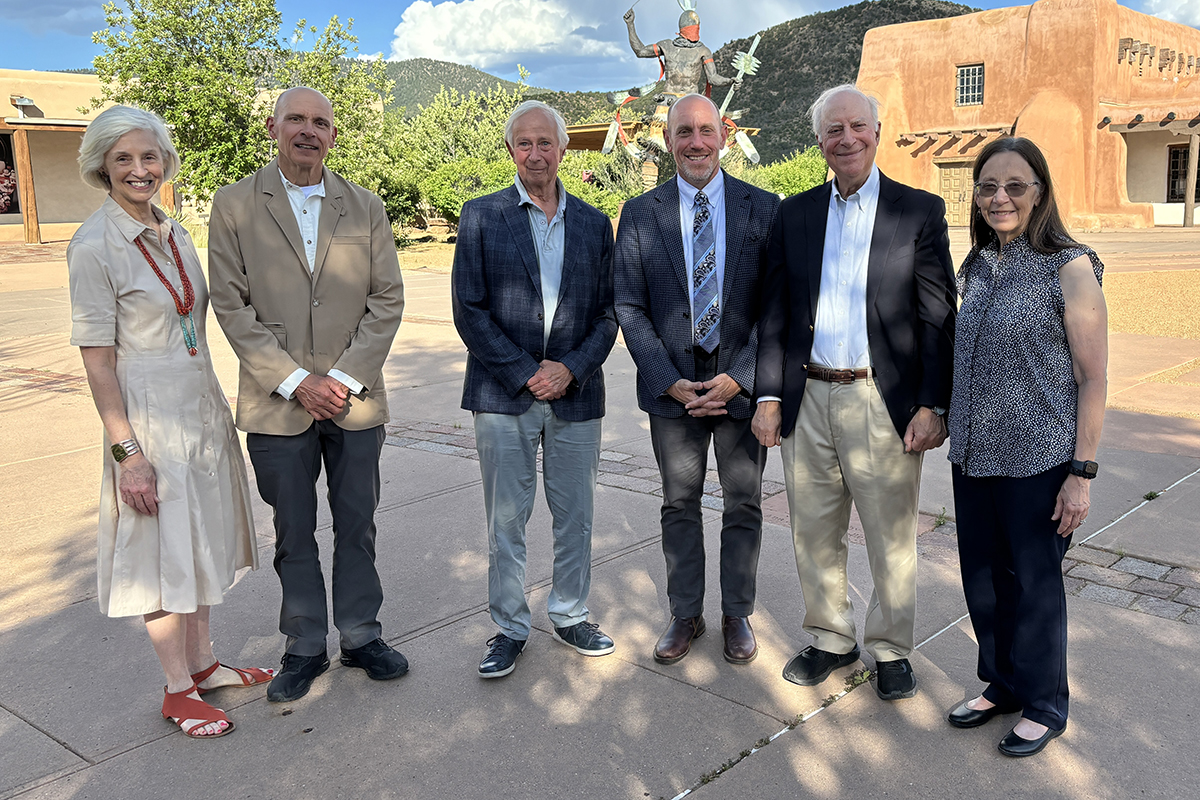
Pictured Above (from left to right): the Hon. Kimberly Mueller, incoming Bolch Judicial Institute director and senior California U.S. district judge; the Hon. Paul Grimm, outgoing director of the Bolch Judicial Institute and retired Maryland U.S. district judge; Richard Brodhead, president emeritus of Duke University; St. John’s College President Walter Sterling; the Hon. David Levi, Duke Law Dean emeritus, outgoing American Law Institute president, and retired California U.S. district judge; and the Hon. Diane Wood, American Law Institute director and retired judge, U.S. Court of Appeals for the Seventh Circuit. Photo Credit: St. John’s College
***
In July, the Bolch Judicial Institute of Duke Law partnered with St. John’s College and the American Law Institute to launch Law and the American Experiment: From Unalienable Rights to a New Birth of Freedom, an intensive seminar series for jurists and lawyers held in Santa Fe.
As an article by Kirstin Fawcett of St. John’s College explains, the program began with a single question: What did the Declaration of Independence mean by “All men are created equal”? Over four days, participants pondered that question through close readings of America’s founding documents — the Declaration of Independence and its original draft, the U.S. Constitution, the Seneca Falls Declaration of Sentiments, and Supreme Court cases from Dred Scott v. Sandford (1857) to Brown v. Board of Education (1954) and Cooper v. Aaron (1958). St. John’s tutors Krishnan Venkatesh and Leah Lasell guided daily text-based discussions, while Duke faculty members Richard Brodhead, Jedediah Purdy, and David F. Levi offered historical and legal context, drawing connections across centuries of debate over justice, equality, and liberty.
Reflecting on these readings, Levi, who is also the Institute’s director emeritus, noted how the country’s founding ideals “came under terrible stress as the country struggled with the problem of slavery that could only be, it turned out, solved by the most violent war in our history. The idea that we would then move forward with amended documents but with the same commitment to this ideal of equal treatment, equal dignity … is the story of America.”
After the seminar, participants emerged with a renewed perspective. “It gave us a sense of the foundations — the organic development of thought that inspired our nation’s founders,” reflects Kimberly Mueller, incoming director of the Bolch Judicial Institute and a senior California U.S. district judge. “They felt so strongly about finding true freedom from oppression and developing an alternative to a monarchy.”